by Jocelyn Watkin | Oct 18, 2026 | Information |

I was intrigued by an interview (on RNZ) with Australian Tom Nash, who lost all four limbs at 19 and has gone on to build a successful career as a podcaster, DJ, entertainment entrepreneur, speaker and author.
What particularly caught my attention wasn’t the inevitable “inspirational” angle. Nash himself rejects that way of looking at his life. Instead, I was struck by his description of his mindset as “anti-fragility, not resilience.”
As he explains it, resilience is the ability to weather a particular storm: “something that gets better due to challenges or stresses or pressures.”
I rather like that distinction. It suggests that life’s challenges don’t always have to be something we simply endure or bounce back from. Sometimes, through adapting and responding to them, we can emerge stronger, more capable or simply different.
It made me wonder: what might our own “anti-fragility” look like? Could we start with the small challenges we encounter in everyday life and consider them as opportunities to adapt, experiment and discover something new about ourselves?
Stress is inevitable in life. The answer isn’t to hide away from it or try to ignore it. Instead, there are numerous health benefits both physically and mentally when we learn how to manage stress and to let go of unnecessary tension in our bodies.
This resonates with tai chi, too. We don’t practise tai chi by trying to be rigidly stable. Instead, we learn to move and respond to change, and to rediscover our balance.
When tai chi is activated as a martial art, it becomes a stronger form of anti-fragility. It’s about learning to redirect and channel an opponent’s energy and force away from you instead of trying to meet it with brute muscular resistance.
Read more about Tom Nash and anti-fragility, and about the three characters he has created help him navigate the times when he feels himself getting down: the artist, the author and the alchemist: https://www.rnz.co.nz/life/people/quadruple-amputee-tom-nash-is-no-victim-or-inspiration
by Jocelyn Watkin | Sep 19, 2026 | Information |

Young people partying
“Youth is wasted on the young.” So goes the famous quote usually attributed to poet George Bernard Shaw.
Older adults might possess the knowledge on how to enjoy life, but often their bodies no longer have the boundless health of youth to fully take advantage of this know-how.
There seems to be a growing fascination with longevity and how to achieve it – not simply wanting to live a long and healthy life, but trying to optimise ourselves so we can squeeze every possible year out of our bodies. How much effort should we put into living longer and will this effort pay off?
A recent RNZ article looked at some of the things New Zealanders are doing in the hope of living longer. Some of it makes perfect sense: getting enough sleep, eating well and taking care of our health. But there is a fine line between looking after ourselves and becoming so obsessed with optimisation that it starts to create stress of its own. https://www.rnz.co.nz/life/wellbeing/what-new-zealanders-are-doing-to-try-and-live-forever-or-at-least-longer
That has even spawned the rather amusing term “maxxing” – taking something we want to improve and trying to maximise it. Sleep-maxxing, for example, can turn the perfectly sensible advice to get enough sleep into an elaborate project involving tracking, monitoring and worrying about whether we’re sleeping well enough. Read more about the stress of ‘maxxing’: https://www.rnz.co.nz/life/wellbeing/our-obsession-with-maxxing-could-actually-be-stressing-us-out
And there is an obvious irony here: if you’re lying awake worrying about achieving the perfect night’s sleep, you may not be helping yourself much!

Lack of sleep (and anxiety about ‘maxxing’ sleep) can lead to poor health
The Fountain of Youth

The mythical Fountain of Youth
The search for ways to beat ageing is certainly not new.
Quests for eternal life or to discover the “Fountain of Youth” date back over 4,000 years – from ancient India, Persia, Greece, Egypt, Mesopotamia (King Gilgamesh), and China (Emperor Qin Shi Huang), and on through the Middle Ages and Renaissance. The so-called “Elixir of Life” was often toxic, and many died early instead of living longer. Read more…
In more recent times, wealthy Americans have been prepared to spend extraordinary amounts of money on treatments and interventions promising to slow or reverse ageing. Plasma transfusions, supplements, elaborate testing and a bewildering array of “anti-ageing” strategies can sound very impressive.
But impressive isn’t the same as proven. For example: Young-donor plasma is a particularly good example of the hype. The US FDA says it is not aware of evidence demonstrating clinical benefit from young-donor plasma for ageing or age-related conditions, and warns that plasma transfusions carry risks. Read more about this.
That doesn’t mean we should abandon sensible health checks or medical care. Screening such as bowel screening and mammograms are important, as are cardiovascular assessments, particularly when there are recognised risk factors or family history.

If you love your health, get regular health check ups. Prevention beats treatment.
In addition, sleep, good nutrition, social activities, reducing stress, and keeping your brain active are all important.
The question is whether more, more expensive and more complicated necessarily means healthier. Check out this article of a wealthy American spending more than $2 million on a quest to stay young.
Perhaps he and others are asking the wrong question? Maybe the goal shouldn’t simply be “How can I live longer?”
Perhaps a better question is: “How can I stay strong, mobile and independent for as long as possible?”
The World Health Organization (WHO) takes a similar approach to healthy ageing. Rather than defining healthy ageing simply as being free of disease or living to a particular age, WHO focuses on maintaining functional ability – being able to move around, meet our own needs, maintain relationships, learn and make decisions, and participate in life. Read more …
In other words, it’s not just about lifespan – how many years we live – but healthspan: how many of those years we can live with good function and independence.
This is where ordinary physical activity starts to look rather impressive.
The benefits of moving and the downsides of falling

As we get older, maintaining strength, balance and mobility becomes increasingly important.
A serious fall can have consequences far beyond the immediate injury: a fracture or other trauma may mean hospitalisation and surgery, followed by weeks or months of reduced activity. Strength can be lost, confidence can take a knock, and fear of falling can lead people to become less active – which can create another downward spiral.
Anything that helps us maintain balance and physical function is potentially doing much more than simply helping us perform better on an exercise test.
And this is where tai chi enters the picture.

With my active tai chi group at Acacia Retirement Village
A 2023 systematic review and meta-analysis brought together 24 randomised controlled trials investigating tai chi and falls in older adults. The researchers found that tai chi reduced the risk of falls and improved several measures of balance and mobility. Read more…
That doesn’t prove that tai chi makes us live longer. But it does provide evidence for something arguably more useful: helping us retain some of the physical abilities that make later life safer, more independent and more enjoyable.
And it isn’t just about preventing falls. Tai chi involves controlled movement, weight shifting, leg strength, coordination, posture, balance and concentration. Practiced regularly, it is a way of continually asking the body and brain to work together.
Maybe we don’t need to “maxx” everything? There is something rather appealing about not ‘maxxing.’
While some are searching for the ultimate longevity intervention, perhaps the most useful things we can do are remarkably ordinary: move regularly, maintain strength and balance, eat reasonably well, sleep as well as we can, stay connected with other people, manage stress and keep doing things that we enjoy.
That is one of the advantages of tai chi. It isn’t a magic potion for longevity. It doesn’t promise to turn back the clock. But it can help us practice living well in the body we have now – and keep doing so as we get older.
The goal isn’t to defeat ageing. Instead, it is to live stronger for longer.
That sounds like a much more enjoyable prospect to me.

by Jocelyn Watkin | Aug 15, 2026 | Information |
Free tai chi in Manurewa – Spring Awakening: Shed winter sluggishness and awaken body energy.

These free sessions will be on the first Saturday of the months of September and October 2026. They will be fun, family-friendly and ideal for beginners. Anyone can attend, whether you live in Manurewa or not.
When: Saturday 5 September 2026, 1:45 – 2:30pm and also at the same time on Saturday 3 October 2026.
Where: Community Room, in the Manurewa Library, 7 Hill Road, Manurewa, Auckland 2102. Refer to map
Price: FREE
Close to public transport: Manurewa Library is a 1-minute walk from the Gt South Road (a main transport route) and a 5 – 10 minute walk from the Manurewa Train Station and bus inter-change. That inter-change is a major South Auckland public transport hub, which is located off Station Road and next to the SouthMall Shopping Centre
Free parking: There’s plenty of free parking (for two hours) at the back of the library (entrance from Hill Road). Plus there is a 1-hour car park in front of the main library entrance (off Newhook Lane)
Age restriction: Open to all ages, but tamariki (children) under 13 need to be accompanied by an adult.
RSVP: Not required, just come along
What to wear: Warm, comfortable clothes that you can move in. Please wear flat-soled shoes like sneakers and trainers. Please also bring a filled water bottle.
Who is the instructor?
Jocelyn Watkin is a Manurewa local and the founder of Kia Ora Tai Chi. She is a qualified and experienced instructor for tai chi, taiji and qigong. These ancient Chinese arts can help you to:
- improve your health and well-being
- reduce stress and anxiety
- improve your balance and help to prevent falls
- boost your immunity
- get fitter without puffing, and
- live stronger for longer.
She has visited China three times, which included training at the sacred Wudangshan (Wudang Mountain), which is the tūrangawaewae of tai chi and qigong. (Tūrangawaewae is a Te Reo Māori word meaning spiritual home or a place to stand where you feel especially connected).
Jocelyn is donating her time so you can attend these sessions at the Manurewa Library for free.
Testimonial from a participant in the 2026 summer tai chi sessions in Cornwall Park: “Thank you so much. We’ve so enjoyed the classes. You’re an incredibly inclusive, encouraging and knowledgeable teacher. We already feel the benefits in terms of flexibility, balance and calm.”
Find out more about Jocelyn: https://www.kiaorataichi.nz/about-us/
If you’d like to have a kōrero (chat) about these sessions, please text or phone Jocelyn on 027 493 9851 or use the Contact Form on the Kia Ora Tai Chi website.

by Jocelyn Watkin | Jul 28, 2026 | Information

Enjoy short outings with some stair walking
I often tell my tai chi students that the best way to learn new steps or movements is to practice them often and regularly.
This doesn’t mean lengthy and laborious sessions. “Bite-sized” chunks are the way to go. Just five minutes per day is better than one long session once per week.
It’s the same with other exercise. “Snacking” on fitness is better than trying to do a marathon. This is especially relevant in winter, when the cold and wet days can tempt us to hibernate.
‘Exercise snacking’ can help us to more-easily keep fit and healthy over winter.
What does it involve? Just a 30-second and up to 5-minute burst of movement several times per day and prioritising these so that they become part of your daily routine.
For example:
- If you’ve been sitting for 20 – 30 minutes, get up for a stretch, get a drink of water, or walk around your house or workplace for five minutes.
- Instead of taking the nearest parking spot to the front door of a supermarket, library, café, or education class, etc, try parking further away in the car park. This means you will walk a little further each time you visit.
- Walk up one flight of stairs, instead of taking the lift.
- Stand or move around while on a phone call or waiting to brew a cup of tea or coffee.
- Buddy up with a friend or a member of your whānau, to learn new forms of exercise or to take longer walks or cycle rides.
- Find an exercise you actually like doing, which also involves learning new steps, such as dancing or tai chi. Spend five minutes 2 – 3 times per day to practice the movements.
- Focus on moving your body rather than aiming for perfection. Just move!!

Buddy up with friends for short cycle rides or walks
There are many health benefits with ‘exercise snacking’. Check out these articles for more info:
by Jocelyn Watkin | Jul 15, 2026 | Information
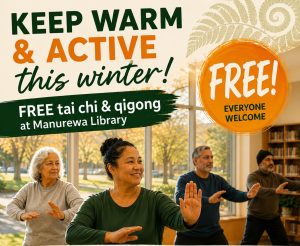
Free tai chi and qigong (chee-gong) on the afternoon of Saturday 25 July 2026. Fun, family-friendly and ideal for beginners. Anyone can attend, whether you live in Manurewa or not.
When: Saturday 25 July, 1:45 – 2:30pm.
Where: Community Room, in the Manurewa Library, 7 Hill Road, Manurewa, Auckland 2102. Refer to map
Price: FREE
Age restriction: Open to all ages, but tamariki (children) under 13 need to be accompanied by an adult.
RSVP: Not required, just come along
Close to public transport: Manurewa Library is a 1-minute walk from the Gt South Road (a main transport route) and a 5 – 10 minute walk from the Manurewa Train Station and bus inter-change. That inter-change is a major South Auckland public transport hub, which is located off Station Road and next to the SouthMall Shopping Centre
Free parking: There’s plenty of free parking (for two hours) at the back of the library (entrance from Hill Road). Plus there is a 1-hour car park in front of the main library entrance (off Newhook Lane)
What to wear: Warm, comfortable clothes that you can move in. Please wear flat-soled shoes like sneakers and trainers. Please also bring a filled water bottle.
Who is the instructor?
Jocelyn Watkin is a Manurewa local and the founder of Kia Ora Tai Chi. She is a qualified and experienced instructor for tai chi, taiji and qigong. These ancient Chinese arts can help you to:
- improve your health and well-being
- reduce stress and anxiety
- improve your balance and help to prevent falls
- boost your immunity
- get fitter without puffing, and
- live stronger for longer.
She has visited China three times, which included training at the sacred Wudangshan (Wudang Mountain), which is the tūrangawaewae of tai chi and qigong. (Tūrangawaewae is a Te Reo Māori word meaning spiritual home or a place to stand where you feel especially connected).
Jocelyn is donating her time so you can attend this session at the Manurewa Library for free.
Testimonial from a participant in the 2026 summer tai chi sessions in Cornwall Park: “Thank you so much. We’ve so enjoyed the classes. You’re an incredibly inclusive, encouraging and knowledgeable teacher. We already feel the benefits in terms of flexibility, balance and calm.”
Find out more about Jocelyn: https://www.kiaorataichi.nz/about-us/
If you’d like to have a kōrero (chat) about these sessions, please text or phone Jocelyn on 027 493 9851 or use the Contact Form on the Kia Ora Tai Chi website.

by Jocelyn Watkin | Jun 28, 2026 | Information
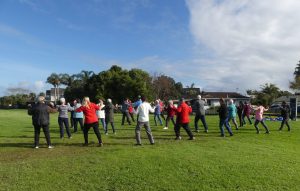
All ages and abilities welcome for FREE tai chi and qigong at Kauri Point Reserve in Wattle Downs, Manurewa, on the official Matariki holiday of Friday 10 July 2026, at 11 – 11.45am.
This will be the 5th year in a row for this wonderful event. Huge thanks to Reshmee, for her amazing and ongoing help and support with this event.
All ages and abilities are welcome. Ideal for beginners.
When: Friday 10 July 2026 (the official Matariki holiday), 11 – 11.45am
Where: Kauri Point Reserve in Wattle Downs, Manurewa, which is at the end of a street called “Moor Park”. (When looking on Google maps, please make sure you select the Kauri Point Reserve in Wattle Downs, otherwise Google maps might direct you to the reserve near Katikati in the Bay of Plenty.)
Try these map links:
https://maps.app.goo.gl/hsexGBHbPuQjwwzc9
https://www.mapquest.com/nz/kauri-point-reserve-432366215
What to bring: A filled water bottle.
If you’d like to join the shared morning tea after the tai chi session: Please bring a small plate of kai (finger food) or snacks to share (that don’t need heating up or require knives & forks to eat).
This is an outdoor event so we need fine weather.
If we have to cancel: If the weather doesn’t co-operate or if the ground is too wet, please look for the cancellation notice by 9am on 10 July on the Kia Ora Tai Chi facebook page: https://www.facebook.com/kiaorataichi
If the event goes ahead, wrap up warm, pop on a beanie and join in.
What sort of tai chi will we be doing?
Together, we will flow through the calming and harmonising Tai Chi for Strength and Balance.
This will be followed by the beautiful Māori Qigong called “Hikitia te Hā” (uplifting breathing), which will be taught in both Te Reo as well as English.
Mauri ora, tai chi whānau! (Wishing you all good health.