by Jocelyn Watkin | May 26, 2026 | Information |

These free sessions will be on the last Saturday of the months of June, July, August and September 2026. They will be fun, family-friendly and ideal for beginners. Anyone can attend, whether you live in Manurewa or not.
When: Saturday 27 June 2026, 1:45 – 2:30pm (and also on last Saturday of the months of July, August and September)
Where: Community Room, in the Manurewa Library, 7 Hill Road, Manurewa, Auckland 2102. Refer to map
Price: FREE
Close to public transport: Manurewa Library is a 1-minute walk from the Gt South Road (a main transport route) and a 5 – 10 minute walk from the Manurewa Train Station and bus inter-change. That inter-change is a major South Auckland public transport hub, which is located off Station Road and next to the SouthMall Shopping Centre
Free parking: There’s plenty of free parking (for two hours) at the back of the library (entrance from Hill Road). Plus there is a 1-hour car park in front of the main library entrance (off Newhook Lane)
Age restriction: Open to all ages, but tamariki (children) under 13 need to be accompanied by an adult.
RSVP: Not required, just come along
What to wear: Warm, comfortable clothes that you can move in. Please wear flat-soled shoes like sneakers and trainers. Please also bring a filled water bottle.
Who is the instructor?
Jocelyn Watkin is a Manurewa local and the founder of Kia Ora Tai Chi. She is a qualified and experienced instructor for tai chi, taiji and qigong. These ancient Chinese arts can help you to:
- improve your health and well-being
- reduce stress and anxiety
- improve your balance and help to prevent falls
- boost your immunity
- get fitter without puffing, and
- live stronger for longer.
She has visited China three times, which included training at the sacred Wudangshan (Wudang Mountain), which is the tūrangawaewae of tai chi and qigong. (Tūrangawaewae is a Te Reo Māori word meaning spiritual home or a place to stand where you feel especially connected).
Jocelyn is donating her time so you can attend these sessions at the Manurewa Library for free.
Testimonial from a participant in the 2026 summer tai chi sessions in Cornwall Park: “Thank you so much. We’ve so enjoyed the classes. You’re an incredibly inclusive, encouraging and knowledgeable teacher. We already feel the benefits in terms of flexibility, balance and calm.”
Find out more about Jocelyn: https://www.kiaorataichi.nz/about-us/
If you’d like to have a kōrero (chat) about these sessions, please text or phone Jocelyn on 027 493 9851 or use the Contact Form on the Kia Ora Tai Chi website.
by Jocelyn Watkin | Mar 4, 2026 | Information

Photo: BLV participants and instructors doing tai chi together in Cornwall Park
Free, outdoor tai chi lessons in Cornwall Park, Auckland, for anyone who is blind or has low vision (BLV).
Dates: Four consecutive Sundays in March 2026: 8th, 15th, 22nd and 29th March. (Weather dependent*)
Time: 10.15am to 11am. Please plan to arrive between 10am and 10.15am. RSVPs are not necessary.
RSVPs are not required. Up to two accompanying family members or support people (per participant) are also welcome and will also be free to attend.
Tai chi location in Cornwall Park: The entrance to the park is at this address: 203 Green Lane West, Epsom, Auckland 1051. The main road into the park is called Pōhutukawa Drive. The tai chi sessions will be under the trees on the left-hand-side about half-way up Pōhutukawa Drive. (If you get to the roundabout, you’ve gone too far.)
What to wear and bring: Please bring your water bottle, a sun hat and sunblock. Wear comfy clothing and shoes. Please don’t wear Jandals or flip-flops.
Age suitability: These classes are best suited to those who are high school age or adults.
Support people: Each participant will be most welcome to invite up to two family members, friends or support people to join them for these tai chi classes.
What is tai chi? Tai chi is a mild martial art and low-impact exercise programme from ancient China. It is sometimes described as “meditation in motion,” as it combines flowing movements with deep breathing and mindfulness. Tai chi tends to be gentle on your joints and is designed to improve balance, mobility, strength and fitness.
Who is the instructor? Jocelyn Watkin of Kia Ora Tai Chi. Jocelyn is a qualified tai chi instructor with specialist skills and experience in teaching tai chi to participants who are blind or have low vision. This includes teaching at Blind, Low Vision New Zealand, BLENNZ Homai, and the BLV unit at James Cook High School in Manurewa.
Jocelyn has been hired by the management of Cornwall Park to teach these tai chi lessons to ensure that attendance is free. You can find out more about Jocelyn on the Kia Ora Tai Chi website: https://www.kiaorataichi.nz/about-us/
*Cancellation notice: As these lessons are outdoors, they depend on good weather. If the weather is not suitable, a decision will be made by 6pm the night before each class (Saturday night). The cancellation notice will be uploaded to the Kia Ora Tai Chi website: https://www.kiaorataichi.nz/ and also the Kia Ora Tai Chi Facebook page: https://www.facebook.com/kiaorataichi
If you are not sure if the lesson will go ahead (due to bad weather) or you need more information, Jocelyn invites you to text or phone her on 027 493 9851.
by Jocelyn Watkin | Nov 5, 2025 | Information
Yes, it’s happening and for the 9th year in a row!! The free summer tai chi and qigong sessions with me in Cornwall Park are back for summer 2026. Please note that these sessions are outdoors so they need fine weather to go ahead. Details below including how to find out about any cancellations.
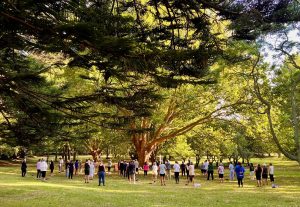
These FREE sessions are outdoors in Cornwall Park from mid-January to the end of March 2026. All welcome, ideal for beginners and suitable for all ages.
Dates and times:
- Sunday mornings, 9 – 9.45am and every Sunday morning (except Sunday 8 February during Waitangi Weekend) until 29th March 2026 (weather permitting)
- Tuesday evenings, 6 – 6.45pm and every Tuesday evening until 31st March 2026 (weather permitting).
Location in the park: Same as in previous years. If coming into the park from Greenlane Road West, you’ll be on Pōhutukawa Drive (the main road into the park). The tai chi sessions will be under the trees on the left-hand-side about half-way up Pōhutukawa Drive. (If you get to the roundabout, you’ve gone too far.)
Bring your water bottle and a sun hat/sunblock. Wear comfy clothing and footwear. Registrations are not required, just show up 5 – 10 minutes before each session starts.
As all of the sessions are outdoors, the weather needs to be on our side to go ahead. If you are uncertain on whether the session will be held you can:
I can’t wait to see everyone again who attended in previous years and also to meet anyone new, who would love to try tai chi and qigong this summer.
Curious about tai chi and qigong? Find out more here: https://www.kiaorataichi.nz/tai-chi/
Please be aware that Cornwall Park is NOT owned by Auckland Council. It is a private park, thanks to the generosity of the founder, Sir John Logan Campbell. He gifted his land, which became known as Cornwall Park, to the people of Auckland. Also, huge thanks to the Cornwall Park Trust Board, which administers his legacy and provides funding for these sessions so you can attend for free.
Contact me or sign up for my free monthly newsletter to get an early ‘heads up’ on when there are even more free sessions of tai chi and qigong.
Tai chi for anyone who is blind or has low vision

Wait, there’s more at Cornwall Park this summer…the Cornwall Park Trust Board are also funding four accessible tai chi sessions for anyone who is blind or has low vision, and who wants to be more active.
The lessons will be held immediately after our general sessions on Sunday mornings and in the same location in the park. The timeslot will be 10.15 – 11am on these four Sundays in March 2026: 8th, 15th, 22nd and 29th. (Weather permitting)
These free tai chi sessions in the park will be designed and developed by me. I have specialist skills and experience in teaching accessible tai chi to adults and young people, including at the Homai campus of Blind, Low Vision Education Network NZ (BLENNZ) and James Cook High School in Manurewa.
Tai chi is gentle on joints and is designed to improve balance, mobility, strength and fitness.
A big thank you to the Cornwall Park Trust Board for funding these accessible sessions.
If you’d like to know how I got started with teaching tai chi to students who were blind/had low vision, it all began with my successful pilot project in 2017. My work in this specialist area has grown from there. You can read a summary of my pilot project in this link: https://www.kiaorataichi.nz/success-with-teaching-tai-chi-to-blind-students/
by Jocelyn Watkin | Jun 15, 2025 | Information
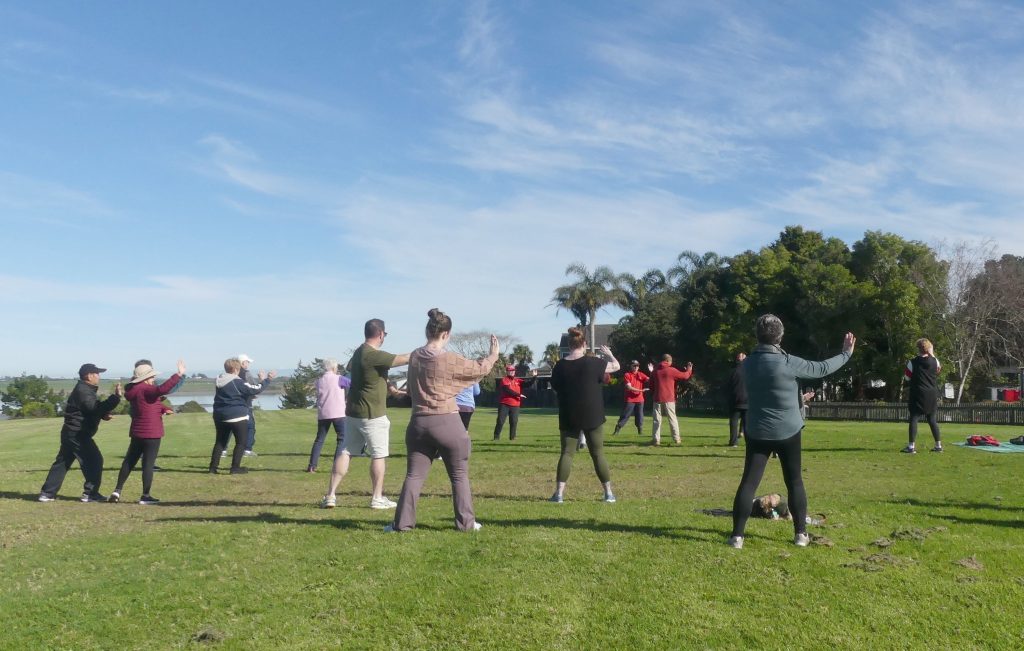
Free tai chi and qigong for Matariki on the Kauri Point Reserve, Wattle Downs, Manurewa
All ages and abilities welcome for FREE tai chi and qigong in the park for the official Matariki holiday.
When: Friday 20 June 2025, 11 – 11.45am
Where: Kauri Point Reserve in Wattle Downs, Manurewa, which is at the end of a street called “Moor Park”. Refer to map: https://goo.gl/maps/MZHeqttC5rBeL6mu9
This is an outdoor event so we need fine weather.
If we have to cancel: If the weather doesn’t co-operate or if the ground is too wet, please look for the cancellation notice by 9am on 20 June on the Kia Ora Tai Chi facebook page: https://www.facebook.com/kiaorataichi/
For more information, get in touch with the organiser (Jocelyn) through the Contact Us page on this website: https://www.kiaorataichi.nz/contact-us/
If the event goes ahead, wrap up warm, pop on a beanie and join in.
Together, we will flow through the calming and harmonising Tai Chi for Strength and Balance followed by the beautiful Māori Qigong called “Hikitia te Hā” (uplifting breathing), which Jocelyn will teach in both Te Reo as well as English.
Matariki (also known as the Pleiades) is a star cluster that heralds the start of the Māori New Year (in mid-winter in Aotearoa/New Zealand). It is a time to focus on mindfulness, reflection, thankfulness, well-being and health.

The Matariki star cluster (also known as the Pleiades)
The three key principles of Matariki are:
- Matariki Hunga Nui. Remembrance. Honouring those we have lost since the last rising of Matariki.
- Matariki Ahunga Nui. Celebrating the Present. Gathering together to give thanks for what we have.
- Matariki Manako Nui. Looking to the Future. Looking forward to the promise of a new year.
The 2025 theme is “Matariki mā Puanga”, which is all about inclusion, embracing diversity and celebrating Matariki together.
More about the theme of Matariki mā Puanga
This phrase means Matariki (the Pleiades) AND Puanga (Rigel), and linking these words together acknowledges the relationship between these stars. Both Matariki and Puanga rise in the eastern sky before sunrise during the winter period. However, due to their geographical location, the Matariki star cluster is not visible at that time to all iwi (Māori tribes) and regions of Aotearoa/New Zealand. Instead, they look to the bright star called Puanga as the harbinger of the New Year.
The phrase Matariki mā Puanga is a reminder that regardless of our different backgrounds, origins, and practices, we use this celebration to come together and share the many unique elements that shape our identity.
For more information, get in touch with Jocelyn through the Contact Us page on this website: https://www.kiaorataichi.nz/contact-us/
Discover more about Matariki: https://www.matariki.com/about
Find more Matariki events: https://www.matariki.com/events
by Jocelyn Watkin | May 6, 2025 | Information

Dreaming of flying towards the sun this winter?
Feeling all shivery in the mornings? What about when curled up under two duvets at night, dreaming of flying north or to the Pacific Islands to follow the sun?
Before you book that one-way ticket, here’s a cosy secret: you can turn up your inner heat right here at home — no passport required.
As the days grow shorter and the chill sets in, many of us start hunting for ways to stay warm without simply cranking up the heater or huddling under several blankets all winter.
Tai chi and qigong might not be the first things that come to mind when you think of keeping warm — but they should be.
So, can tai chi really help quell the quivery shivers of winter?
Yes, absolutely.
Tai chi and qigong are gentle forms of exercise, which means they’ll warm your body just as any physical movement does. But they go far beyond that.
The magic lies in the how. Slow, flowing movements combined with deep, mindful breathing do more than just get your blood moving — they improve your circulation and help your body absorb oxygen more efficiently.
Unlike high-intensity workouts that burn through your oxygen and leave you gasping, tai chi and qigong cultivate a quiet, lasting energy that lingers long after your practice ends.
That’s why so many practitioners describe a subtle, comforting warmth spreading through their bodies — not just during the session, but for hours afterward.
In the world of Traditional Chinese Medicine, this warmth has an even deeper explanation. Tai chi and qigong help to cultivate your qi — your life force, your mauri — which is believed to support your body’s natural defenses and resilience. A strong flow of qi is said to help you withstand not just winter’s chill, but also many seasonal bugs and fatigue.
And it’s not just ancient wisdom saying this. Modern research backs it up, too. Studies show tai chi and qigong can positively influence immune system functioning and reduce inflammation — helping you feel stronger and more energised during the colder months.
Explore the science here: https://www.kiaorataichi.nz/tai-chi-and-qigong-can-boost-immunity/
So next time you reach for another pair of socks or wrap yourself in a blanket, consider this: tai chi and qigong could be your warmest allies this winter.
I welcome new beginners at my tai chi classes in Clendon, Manurewa, on Wednesday evenings, 6.30 – 7.15pm. Your first class is free. Find out more: https://www.kiaorataichi.nz/classes/
The photo above of me practising tai chi in the glow of a huge, close-up photo of the sun was taken at the ‘Astronomy Photographer of the Year’ exhibition, Te Whare Taonga o Waikato Museum & Gallery, in Hamilton. https://tewharetaonga.nz/